Resumen de la decisión SCOTUS IEEPA
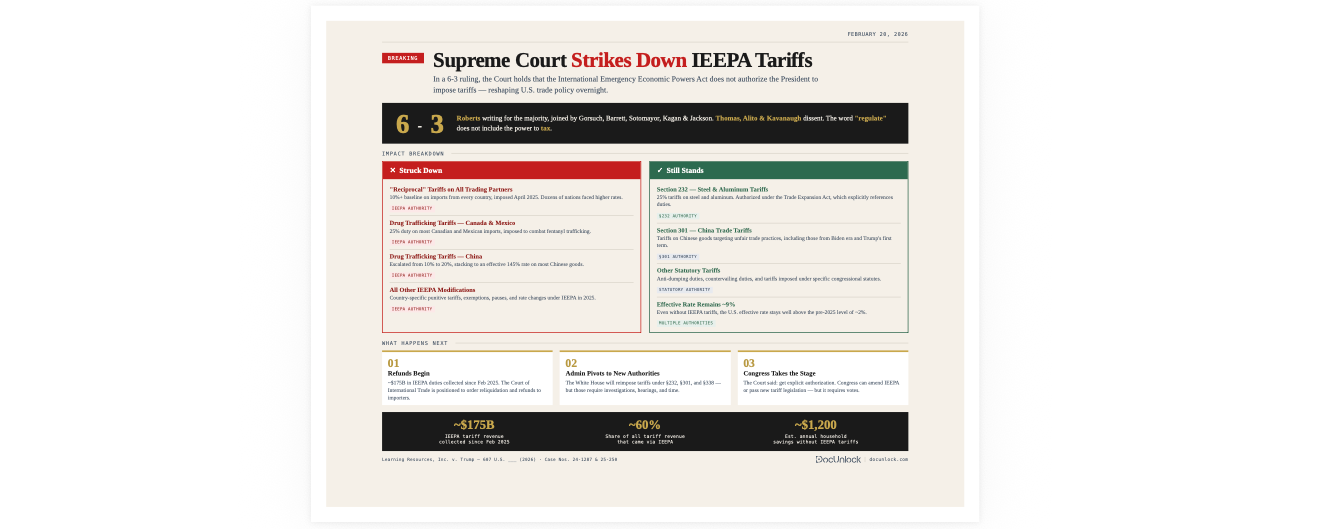
Descargue el gráfico de preguntas frecuentes aquí
La Corte Suprema acaba de anular los aranceles de la IEEPA. Esto es lo que significa. En una sentencia de 6 a 3 emitida hoy, el Tribunal sostuvo que la Ley de Poderes Económicos de Emergencia Internacional no otorga al Presidente la autoridad para imponer aranceles. El presidente del Tribunal Supremo Roberts, junto con Gorsuch, Barrett, Sotomayor, Kagan y Jackson, escribió la opinión mayoritaria. Thomas, Alito y Kavanaugh discreparon.
La pregunta central: ¿la facultad de «regular la importación» incluye la facultad de gravarla? El Tribunal dijo que no. La IEEPA enumera nueve medidas específicas que el presidente puede tomar: investigar, bloquear, regular, dirigir, obligar, anular, anular, impedir, prohibir, y ninguna menciona los aranceles o aranceles. Cada vez que el Congreso delega la autoridad tarifaria, lo hace de manera explícita y con restricciones claras. El Tribunal consideró inverosímil que el Congreso ocultara la facultad de gravar con la palabra «regular».
Qué ha sido derribado:
→ Los aranceles «recíprocos» (más del 10% de referencia para todos los socios comerciales)
→ Aranceles al tráfico de drogas en Canadá, México y China (25% y tasas crecientes de hasta el 145%)
→ Todas las modificaciones, exenciones y ajustes basados en la IEEPA a partir de 2025
Lo que sigue en pie:
→ Aranceles de la Sección 232 sobre el acero y el aluminio (diferente autoridad legal que hace referencia explícita a los aranceles)
→ Aranceles del artículo 301 sobre China (prácticas comerciales desleales — ley separada)
→ Derechos antidumping y compensatorios en virtud de otras leyes del Congreso
→ El tipo arancelario efectivo de EE. UU. sigue rondando el 9%, por debajo del ~ 18%, pero muy por encima del tipo anterior a 2025 del ~ 2%
Qué sucede a continuación:
→ Se han recaudado aproximadamente 175 mil millones de dólares en derechos de la IEEPA desde febrero de 2025. El Tribunal de Comercio Internacional está en condiciones de ordenar reembolsos.
→ La Administración ha señalado que recurrirá a las autoridades de las Secciones 232, 301 y 338 para volver a imponer los aranceles, pero esos aranceles requieren investigaciones, audiencias y tiempo.
→ El Congreso puede autorizar explícitamente el poder tarifario si así lo desea.
El mensaje del Tribunal fue claro: esta decisión pertenece al poder legislativo. No hay un período de transición. Esto entra en vigor de forma inmediata. Eso no significa que tus reembolsos sean automáticos.
Para los agentes de aduanas: esto tiene enormes consecuencias. La complejidad operativa que supone reducir los aranceles de la IEEPA, procesar las solicitudes de reembolso y preparar las tarifas sustitutivas con las nuevas autoridades pondrá a prueba los sistemas y la capacidad de todas las agencias de corretaje. Los corredores que se adapten más rápido ganarán.